
If your designs look “almost right” but not polished yet, the problem is rarely talent. The real gap is usually practice structure. Learning how to improve graphic design skills at home becomes easier when you train your eyes, your tools, and your decision-making at the same time.
I have found that random tutorials only help for a while. Real progress happens when I study one principle, apply it to one design, ask for feedback, then rebuild the same piece better.
Why Home Practice Can Actually Make You Better
Home gives you one major advantage: repetition without pressure. You can redesign a flyer five times, compare versions, and learn from mistakes without a client waiting.
Strong graphic design is not just about making something attractive. Nielsen Norman Group explains that visual hierarchy helps guide attention through scale, contrast, color, and grouping. That means your design must control where the eye goes first, second, and third.
Master Graphic Design Fundamentals First
Learn Visual Hierarchy Before Effects
Before adding shadows, gradients, or textures, ask one question: what should the viewer notice first?
Use size, bold type, spacing, and contrast to create order. If everything looks important, nothing feels important. This one habit can instantly make posters, thumbnails, social graphics, and website sections look more professional.
Practice Typography Like A Designer
Typography can make a beginner design look advanced or messy within seconds. Start with simple font pairing. Use one font for headings and one for body text.
Pay attention to tracking, leading, alignment, and line length. A clean type layout often beats a busy graphic with too many decorative fonts.
Use White Space With Confidence
White space is not wasted space. It gives your layout breathing room and helps people understand the message faster.
When I revise a cluttered layout, I usually remove one color, one font style, and one extra graphic element. The design often improves immediately.
Build Tool Skills Without Becoming Tool-Dependent
Learn Photoshop, Illustrator, And Figma With Purpose
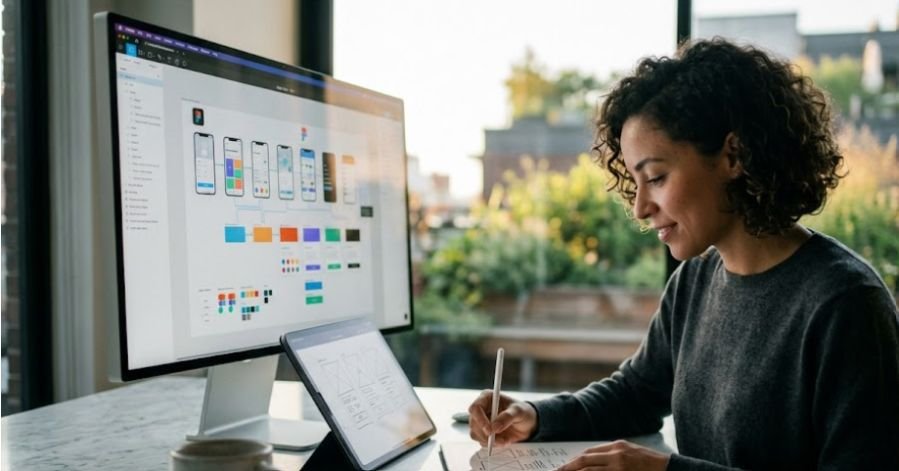
Photoshop is useful for image editing. Illustrator is better for logos, icons, and vector artwork. Figma helps with layouts, UI design, web components, and collaborative design. Figma’s own learning resources cover basics like frames, shapes, text, auto layout, components, and prototyping.
Do not try to learn every feature at once. Pick one tool and one outcome. For example, create a poster in Photoshop, a logo in Illustrator, or a landing page section in Figma.
Use Keyboard Shortcuts Early
Speed matters because slow execution breaks creative flow. Adobe notes that Illustrator keyboard shortcuts help designers work faster and more productively.
Start with shortcuts for selection, text, zoom, duplicate, grouping, layers, and export. Once these become automatic, your brain can focus more on design decisions.
Use The Copy, Critique, Rebuild Method
This is my favorite home practice system for learning how to improve graphic design skills at home because it trains your eye and hand together.
First, choose one strong design from Behance, Dribbble, a magazine cover, or a brand campaign. Recreate it as closely as possible. Do not publish it as original work. Use it only for private learning.
Second, critique it. Ask why the designer used that type size, color contrast, spacing, and image crop.
Third, rebuild it with a new topic. For example, turn a coffee poster into a fitness class poster while keeping the same structure.
This method teaches design thinking faster than watching five passive tutorials.
Try Practical Graphic Design Exercises At Home
Redesign Bad Everyday Designs
Take a messy restaurant menu, local flyer, old website banner, or confusing social post. Rebuild it with better spacing, hierarchy, and typography.
This exercise works because the problem already exists. You are not starting from a blank screen. You are solving a visible communication issue.
Limit Your Design Choices
Creative limits build better decisions. Try making one design with only two colors, one font family, and no stock images.
This forces you to rely on spacing, scale, alignment, and contrast. Those are the skills that separate polished designers from template users.
Create Fake Client Briefs
Write small briefs for yourself. For example, create a logo for a local bakery, a social media post for a fitness coach, or a landing page hero section for a productivity app.
Give yourself a deadline. Real design work always includes limits, so practice with limits from the beginning.
Get Feedback Before You Build A Portfolio
Designing alone can create blind spots. You may love a layout because you spent hours on it, not because it works.
Post your work in design communities and ask specific questions. Ask, “Is the hierarchy clear?” or “Does the type pairing work?” Avoid asking, “Do you like it?”
Feedback becomes more useful when the question is clear.
Build A Simple Home Portfolio
A beginner portfolio does not need twenty projects. Five strong case studies are better than twenty random graphics.
For each project, show the brief, problem, design process, final result, and what changed after feedback. This proves that you can think, revise, and solve problems.
Include different formats such as a logo, poster, social media graphic, website section, and brand style sample.
FAQs
1. How can beginners improve graphic design skills at home?
Beginners can improve by studying design principles, recreating professional layouts, practicing daily, learning core tools, and asking for feedback.
2. What should I practice first in graphic design?
Start with typography, spacing, alignment, contrast, and visual hierarchy before moving into effects, branding, or advanced software skills.
3. Can I learn graphic design at home without a degree?
Yes, you can learn at home through structured practice, online resources, real design exercises, critique, and a focused portfolio.
4. How long does it take to improve graphic design skills at home?
Most beginners see visible improvement in 60 to 90 days with consistent practice, weekly feedback, and repeated redesign exercises.
The Glow-Up Is In The Rebuild
Learning how to improve graphic design skills at home is not about collecting more tutorials. It is about training your judgment through practice, critique, and revision.
Start with one weak design today. Rebuild it with better spacing, clearer type, stronger contrast, and fewer distractions. Then compare both versions. That comparison is where the real learning happens.